









Speaker
Description
Shale serves as a crucial subsurface reservoir for energy-related processes, including shale gas production, geological carbon storage (CCUS) (Ma et al.,2021), and underground hydrogen storage (Wang et al., 2024). However, the extreme heterogeneity of shale pore structures poses a fundamental challenge for permeability characterization, as existing imaging techniques suffer from an inherent trade-off between spatial resolution and field of view. High-resolution methods such as focused ion beam–scanning electron microscopy (FIB-SEM) resolve nanoscale pores but are limited to micrometer-scale volumes that are far smaller than the representative elementary volume (REV) (Wei et al., 2023), whereas large-scale techniques such as micro-/nano-CT fail to capture intra-mineral pore structures (Gou et al., 2019).
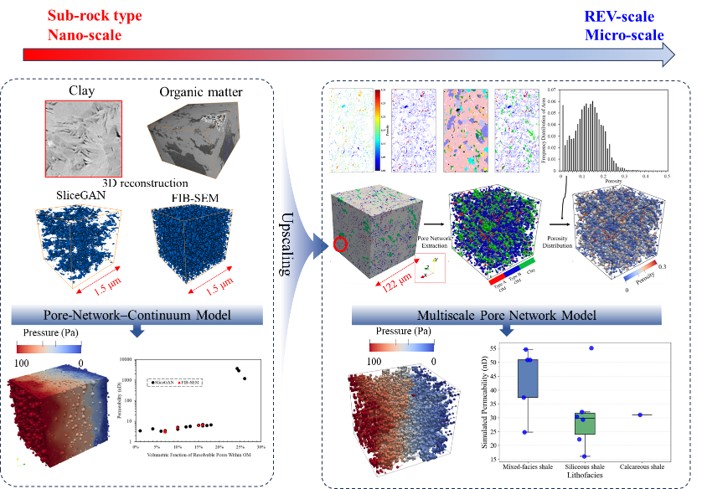
To overcome this limitation, we propose a multiscale upscaling framework that integrates high-resolution pore information into a REV-scale (122 μm) digital shale core. Based on large-area MAPS images, shale pore-bearing components are classified into sub-rock types, including two organic matter types with distinct pore connectivity (Type A and Type B) and clay minerals. For each sub-rock type, pore structure characteristics are quantified from SEM and FIB-SEM images, and intrinsic permeability–porosity relationships are established using a multiscale pore-network–continuum model. These permeability functions are then mapped onto a reconstructed REV-scale digital core through a statistical upscaling procedure, thereby preserving nanoscale pore information at the REV scale (as illustrated in Figure 1). Using this approach, we numerically predict the apparent permeability of multiple reconstructed of shale matrix, and the simulated results show good agreement with experimental permeability measurements, demonstrating the reliability of the proposed framework. REV-scale connectivity and permeability analyses further reveal that mixed-facies shales exhibit the highest average permeability, followed by calcareous and siliceous shales. In addition, permeability generally increases with increasing clay mineral and organic matter contents, reflecting enhanced pore connectivity.
This study provides a quantitative permeability prediction method for shale based on two-dimensional MAPS imaging combined with multiscale digital rock modeling. The proposed framework enables reliable permeability evaluation at the REV scale while accounting for nanoscale pore heterogeneity, offering new insights into pore connectivity controls in shale and practical guidance for the late-stage development of shale gas reservoirs.
| References | [1] Ma, L., Fauchille, A.-L., Ansari, H., Chandler, M., Ashby, P., Taylor, K., Pini, R., and Lee, P. D. (2021). Linking multi-scale 3D microstructure to potential enhanced natural gas recovery and subsurface CO2storage for Bowland shale, UK. Energy & Environmental Science, 14(8), 4481-4498. doi:10.1039/d0ee03651j [2] Wang, Y., Sun, Q., Chen, F., and Wang, M. (2024). Multiscale Model for Hydrogen Transport and Storage in Shale Reservoirs. SPE Journal, 29, 1-27. doi:10.2118/219472-PA [3] Wei, J., Zhou, X., Shamil, S., Yuriy, K., Yang, E., Yang, Y., and Wang, A. (2023). Lithofacies influence characteristics on typical shale pore structure. Energy, 282. doi:10.1016/j.energy.2023.128728 [4] Gou, Q., Xu, S., Hao, F., Yang, F., Zhang, B., Shu, Z., Zhang, A., Wang, Y., Lu, Y., Cheng, X., Qing, J., and Gao, M. (2019). Full-scale pores and micro-fractures characterization using FE-SEM, gas adsorption, nano-CT and micro-CT: A case study of the Silurian Longmaxi Formation shale in the Fuling area, Sichuan Basin, China. Fuel, 253, 167-179. doi:10.1016/j.fuel.2019.04.116 |
|---|---|
| Country | China |
| Acceptance of the Terms & Conditions | Click here to agree |